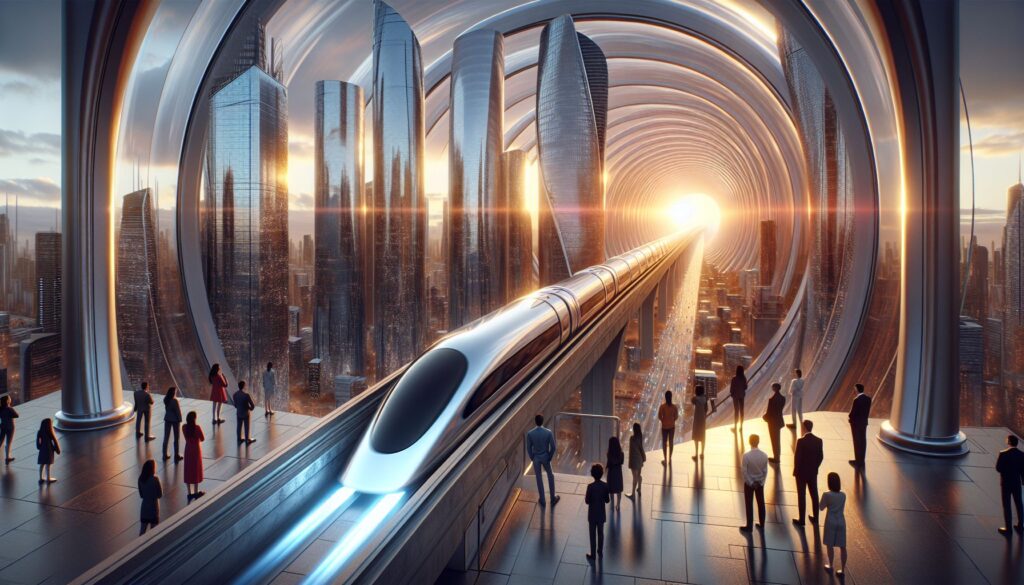
Hey techno-enthusiasts! Today, I want to talk about something that’s been on my mind lately—Hyperloop technology. You know, that wild concept of shooting passenger pods through vacuum tubes at nearly the speed of sound. Yeah, that one! As a self-proclaimed tech geek and an avid traveler, the idea of zipping from Los Angeles to San Francisco in under 30 minutes has always tickled my fancy. Who needs teleportation when you can travel in a sleek, high-speed capsule that feels like it’s straight out of a sci-fi movie?
The Birth of the Hyperloop
The concept of a high-speed tube-based transport system isn’t exactly new, by the way. It’s been bouncing around since the 19th century, much like my enthusiasm when I read my latest tech brief. Our modern take on the Hyperloop, though, can be traced back to our good friend Elon Musk, who revived the idea and pitched it to the world in 2013. He envisioned a system where pods zoomed through low-pressure tubes, reducing drag and energy consumption. Basically turning long-distance travel into something that takes about as long as a Netflix episode.
Musk, true to his disruptor nature, open-sourced the idea, inviting companies and researchers worldwide to bring his vision to life. And boy, did they rise to the challenge! Now, various startups, like Virgin Hyperloop and Hyperloop Transportation Technologies, are racing to make these ultra-fast travel dreams a tangible reality.
How Does It Work?
Alright, here’s a quick run-through if you’re not familiar with the basics: the Hyperloop works by propelling pressurized capsules—or “pods”—through a network of tubes with low air pressure. This nearly frictionless environment allows for incredibly high speeds, theoretically reaching over 700 mph! Think of it as flying on the ground without turbulence or weather delays, and more legroom than you get in most airlines’ economy class.
The propulsion is typically handled by electromagnetic acceleration, and levitation is achieved using magnetic levitation tech. Sounds fancy, right? The combination reduces friction and energy use, allowing for efficient and sustainable travel. Also, its eco-friendly credentials get a boost from the fact that Hyperloop systems can be powered by renewable energy sources like solar panels.
The Hurdles on the Hyperloop Highway
While the Hyperloop concept sounds as cool as a cucumber in a fridge, it’s not without its challenges—technical, financial, and regulatory. Let’s start with the technical bit. Building a tube that maintains low pressure over hundreds of miles isn’t a piece of cake, and neither is achieving the levitation and control involved in this exercise of futuristic roller coasters. But hey, if engineers can (almost) get us to Mars, we’ve got a fighting chance.
On the financial side, the initial cost of infrastructure is pretty high. These projects require massive investments in land, materials, and tech development. But as we’ve seen with other tech advances, costs tend to drop as innovations become more widespread.
Regulation is another bump on this futuristic path. Navigating through the existing maze of transport regulations and safety standards is like playing a strategy game where the rules keep changing. Transport authorities will need assurances about passenger safety, emergency protocols, and the environmental impact, among other factors.
Why Are We Excited? Instant Gratification!
Hyperloop represents the holy grail of instant gratification for travelers. Living in an era where everything’s on-demand—movies, food, even dates—it seems only right that our transportation should catch up. Imagine living in one city but working in another several hundred miles away, without breaking a sweat over long commutes. The possibilities for urban planning, real estate, and the job market are mind-boggling, and I’m here for this brave new world.
Plus, this could be the game-changer for reducing traffic congestion and pollution in megacities. By offering an alternative to cars and traditional trains, Hyperloop could help decongest our cities and make them cleaner and quieter.
Looking Ahead: The Future is Tubular
Let’s do a little speculation here because, let’s face it, it’s the fun part. If Hyperloop technology sees widespread adoption in the next few decades, we could be living in a connected world where the concept of “distance” almost becomes trivial. Realistically speaking, the initial routes are likely to focus on linking major cities where the demand can justify the cost—places like the Los Angeles-San Francisco corridor, the New York-Washington D.C. line, or European travel hubs.
In the future, who’s to say we wouldn’t expand these networks beyond just inter-city travel? Maybe someday, we’ll see a transcontinental Hyperloop system, connecting continents in just a couple of hours. Who needs jet lag when you can reach New York from London in your lunch break, right?
Conclusion
As we stand on the edge of what might be the next great leap in transportation, the ride promises to be as thrilling as the destination. Hyperloop tech is stirring up the status quo, much like how the internet changed communication forever, promising a new era in travel that’s faster, cleaner, and just plain cooler.
So, whether you’re a tech evangelist, a climate warrior, or simply someone who’s perpetually late and dreads traffic, the Hyperloop could very well be the answer to many of our travel woes. I can’t wait to see how it all pans out, and maybe even take my first ride on one of these magic tubes. Because, honestly, who wouldn’t want to experience the future of travel firsthand?
If you’ve got thoughts, dreams, or conspiracy theories about the Hyperloop, hit me up! Let’s nerd out together. Until next time, keep dreaming high and speeding fast!