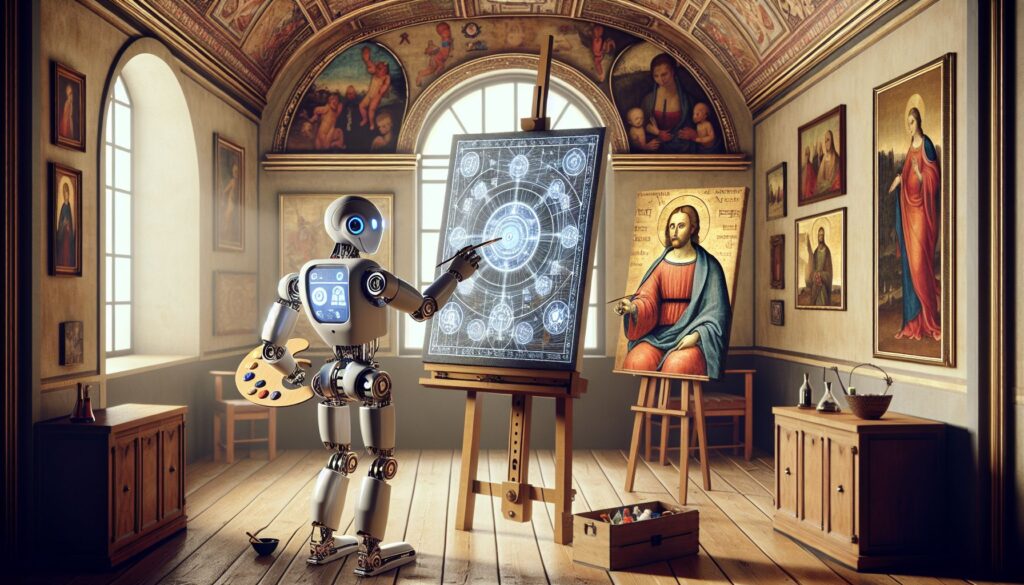
When you think of artificial intelligence, what comes to mind? Maybe self-driving cars weaving through traffic like something out of a sci-fi movie? Or virtual assistants patiently answering “what’s the weather” for the millionth time? AI has become a jack-of-all-trades with many impressive feats under its belt, but there’s one arena where it’s really starting to surprise me: the creative arts. Yes, that’s right! AI is becoming the new muse, making waves and shaking up traditions with its relentless curiosity and untapped potential. Let me walk you through this fascinating collision of technology and creativity.
The Rise of AI’s Artistic Flair
For the longest time, art felt like humanity’s unbreachable stronghold. We believed art required that ineffable human touch, a heart, a soul, a… well, you get it. But AI has been blurring those lines with growing sophistication. Remember when an AI-generated portrait sold for $432,000 at a Christie’s auction? That was wild. Or the time when OpenAI’s DALL-E introduced us to some trippy, but oddly accurate, images when asked to merge objects or concepts? AI isn’t just joining the art party. It’s bringing some outrageous new tunes to the dance floor.
AI: The New Brush in the Artist’s Toolkit
What makes AI a game-changer in art isn’t just its ability to generate images but how it transforms the artistic process itself. Artists now collaborate with AI, using tools like DeepArt to infuse AI-generated insights into their art. Instead of a replacement, AI acts like a companion, a fellow creator that prompts artists to explore new styles and techniques. It’s almost like having Bob Ross as software, gently whispering happy little accidents into your digital brushstrokes.
Generative Adversarial Networks (GANs) drive these creative endeavors. By setting up a little AI rivalry, one algorithm constantly pushes against the constraints set by another. GANs perfect images by learning from errors. The result? Artworks that surprise even the creators.
The AI Playwrights and Composers
It’s not all about visuals. AI has its hands all over music and writing, too. In music, tools like AIVA (Artificial Intelligence Virtual Artist) and OpenAI’s MuseNet can generate complex, compelling compositions. They take inputs as ethereal as mood or genre to weave entirely new soundscapes. Who knew an algorithm could jam like the greats!
In the realm of words, AI authorship is becoming less of a novelty and more of the norm. Language models like GPT-3 craft prose and poetry that engages and, in some cases, moves us. Imagine a world where your favorite author has a digital doppelganger, ready to create spin-off stories or explore alternate plot lines on demand. Sure, not every AI-generated poem will bring tears to your eyes, but wasn’t Shakespeare’s debut a bit rough around the edges too?
Finding the Muse in Machines
The secret sauce behind these creative accomplishments is AI’s capacity to analyze and learn from vast amounts of artistic data and emulate styles across cultures and historical periods. Let’s face it: some artists spend years studying just one genre. AI can assimilate millennia in milliseconds. Want a Broadway musical styled like Mozart with a splash of 1980s synth? There’s an algorithm for that.
Tackling Challenges and Embracing the Future
While AI feels like a fountain of endless creative possibilities, it’s not all smooth sailing. There are several hurdles to overcome. For instance, who owns AI-created art? Is it the developer, the user, or the AI itself? If AI can create, compose, and write at scale, what happens to human artists? Does it belittle artistic endeavor, or democratize it?
Many purists argue that AI art lacks the “genuine emotional strife” that characterizes human creativity, a sentiment that’s valid, yet perhaps somewhat myopic. AI art introduces vagueness in authorship but brims with imagination, challenging us to redefine our understanding of creativity itself.
A Vision of Tomorrow
Looking ahead, AI in the creative arts will likely meld further with virtual and augmented reality platforms, offering immersive experiences that are both physically and emotionally resonant. Imagine interacting with an AI artist at a virtual gallery, discussing its latest piece as it renders a new one in real-time based on your feedback. A smooth blend of creation and experience.
Conclusion: Tool or Artist?
So, is AI a mere tool, or an artist in its own right? As with most transformative technologies, the answer isn’t binary. Instead, AI holds the potential to inspire a new era of creativity, where human and machine collaborate. By teaming up with AI, artists will continue pushing boundaries, inviting us to re-evaluate the essence of art itself. We stand at the precipice of what’s arguably a reboot of the Renaissance, only this time, we’ve got robots sketching the Mona Lisa 2.0. I can’t wait to see what kinds of masterpieces emerge from this strange new partnership.